Spreadsheets are fine until they aren't
If you really want to understand a company, look at how it handles the boring bits.
Anyone can weld something tidy or write a sharp proposal, but it’s the systems underneath that decide whether a business grows or trips over its own shoelaces. At Terra, we’ve always leaned towards doing things properly, long before any formal standard told us we should.
When I first started putting together our Quality, Environmental, and Health & Safety systems, I did what any sensible small business does. I opened a blank page and began from scratch. A few simple templates, some spreadsheets, a lot of reading, and a clear picture of what “good” should look like. Nothing glamorous, just proper old school thinking and a determination to build something that reflected how we actually work, not how a generic guide thinks we should.
Those early documents weren’t perfect, but they forced us to ask the right questions.
How do we prove we’re doing things safely?
How do we stay consistent as we grow?
How do we capture knowledge so the company scales, not just the workload on the team?
How do we make continuous improvement something real, not just a phrase?
Every answer shaped a better process, a clearer workflow, or a more disciplined way of approaching the job. Then, slowly, the bigger picture appeared. We weren’t “preparing for ISO”, we were engineering a system the same way we engineer equipment - deliberately, with precision, and built to last.
As with anything that starts small and grows quickly, we hit the familiar point where things start showing their limits. Spreadsheets were fine until they weren’t.
Version control became a chore.
Logs lived in folders that made sense to one person, but not another.
Processes needed more structure than a shared drive could ever offer.
If we wanted the system to be audit ready, scalable, and actually useful day to day, it couldn’t just exist. It needed to live somewhere built for improvement, not storage.
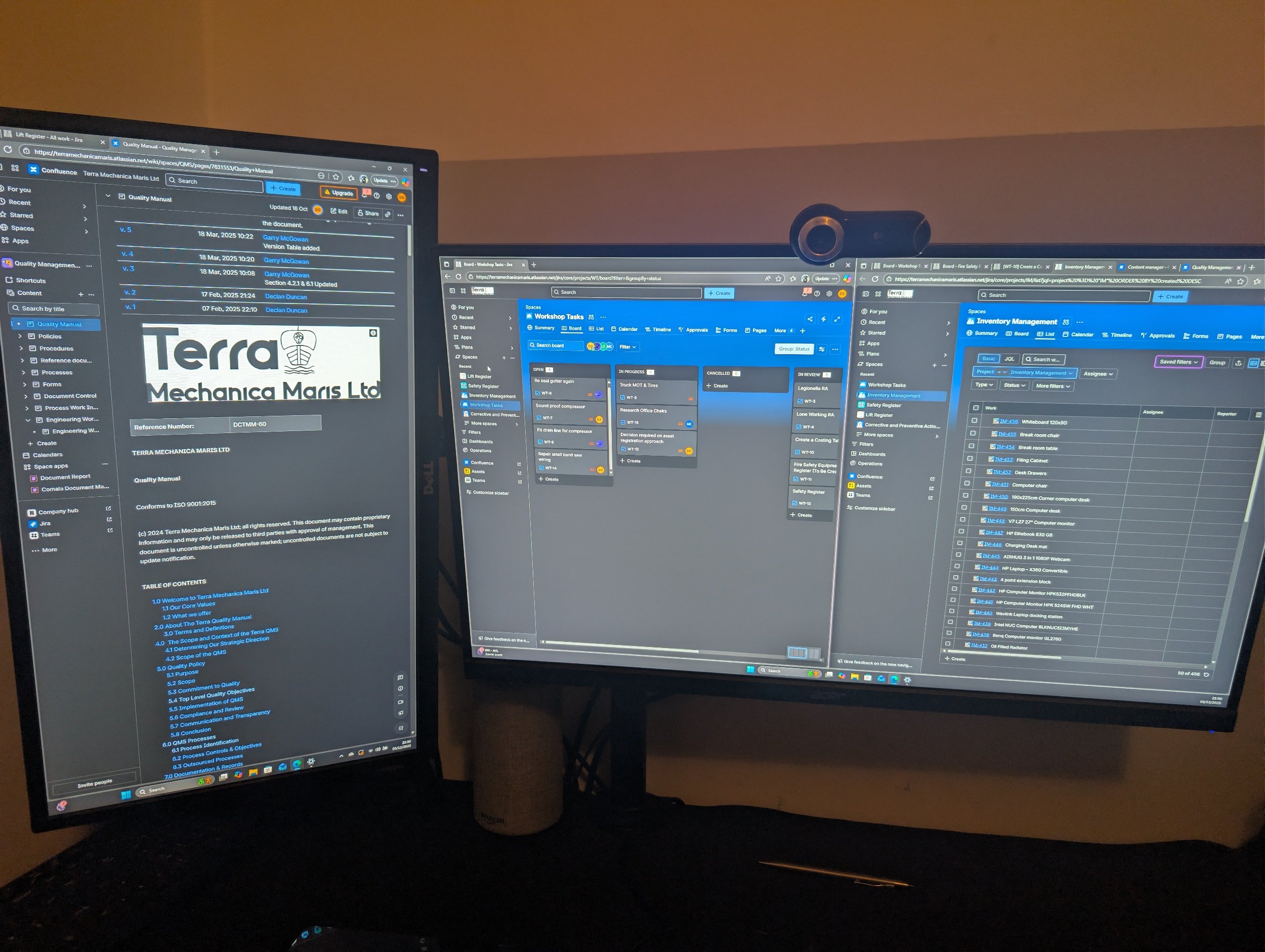
So we moved to Atlassian.
Calling Atlassian “software” doesn’t really cover it. For us, it became part of the backbone of the business.
Confluence turned our scattered documents into a structured, living Quality Management System. One that anyone can navigate without a map.
Procedures now have version histories.
Risks have owners.
Registers link directly to the workflows they influence.
Everything is traceable, organised, and consistent not because someone remembers, but because the system enforces it.
Then there’s Jira which quickly became the engine room. Corrective actions, engineering changes, maintenance schedules, training logs… everything suddenly had a home and a proper workflow. Nothing got lost. Nothing sat unnoticed. Nothing relied on one person’s memory.
Tasks assign themselves.
Risks escalate automatically.
Procedures notify the right people when they change.
Improvements track themselves.
It was a way to tidy the company, and it rewired how we operate.
Why does that matter? Because ISO isn’t a badge for us. It’s not a box tick or a client requirement. It’s proof that the standards we talk about are the standards we actually live by.
The Atlassian software gave us the alignment we didn’t realise we were missing. Now the workshop, the fabrication bay, the office, the offshore prep - every part of Terra - speaks the same language and follows the same structure.
It’s no longer “someone’s job to remember.” It’s the company’s job to record, track, and act.That consistency strengthens the business as much as it simplifies audits.
We’re now closing in on ISO 9001, ISO 14001, and ISO 45001 certification not because we had to, but because the systems we’ve built deserve recognition.
Looking back, the shift from sketchy documents built from scratch to a full cloud based management system marks a turning point. It’s one of those changes you don’t fully appreciate until you see what came out the other side: a company more organised, more capable, and more resilient than ever.
We’ve entered the stage where structure creates momentum.
Where processes speed things up, not slow them down.
Where the system we built begins paying us back.
ISO was never the destination. It’s just the confirmation that we’re building Terra the right way. Deliberately, piece by piece, with structure, logic, and purpose. Exactly how a good system should be.